


Dr Khoo Zhi Lin Deanna
Cardiologist


 Add as a preferred source on Google
Cardiologist
While chest pain or pressure is still the most common symptom of a heart attack, women are more likely than men to also experience pain in the back, jaw, or neck, sudden extreme fatigue, nausea, or breathlessness – sometimes without obvious chest pain at all.
These symptoms can build gradually or come on suddenly, and because they can resemble less serious conditions, they're often mistaken for something else.
Chest pain or discomfort is still the most common heart attack symptom in women, reported by over 80% of women having a heart attack – but women are more likely than men to also have one or more of the following (Mehta et al., 2016; Mayo Clinic, 2024):
Any of these on their own, or several together, are reason enough to seek emergency care immediately – women don't need to have classic chest pain for it to be a heart attack.
The biggest difference isn't that women don't get chest pain (most do), but that women are more likely to also have symptoms that don't obviously point to the heart, which makes it easier to dismiss or misattribute what's happening (Mehta et al., 2016).
This shows up in local data too. A Singapore Myocardial Infarction Registry analysis of heart attack patients aged 20 to 64 found that younger women were more likely than men to have atypical symptoms, a prior history of ischaemic heart disease, and a worse 28-day survival rate – differences that disappeared in patients over 64 (Kam et al., 2002).
Why younger women in particular present differently isn't fully understood.
Dr Deanna Khoo, cardiologist at Gleneagles Hospital, shares: "Younger women who develop a heart attack may have a broader range of underlying mechanisms, including coronary artery spasm, microvascular dysfunction, and spontaneous coronary artery dissection, in addition to conventional atherosclerotic coronary disease. There may also be sex-related differences in autonomic responses, pain perception, and the way ischaemic symptoms are experienced and described."
Singapore Heart Foundation data also shows that while heart attacks occur more often in men, the fatality rate is higher in women, largely because women tend to be older when a heart attack occurs (Singapore Heart Foundation, n.d.).
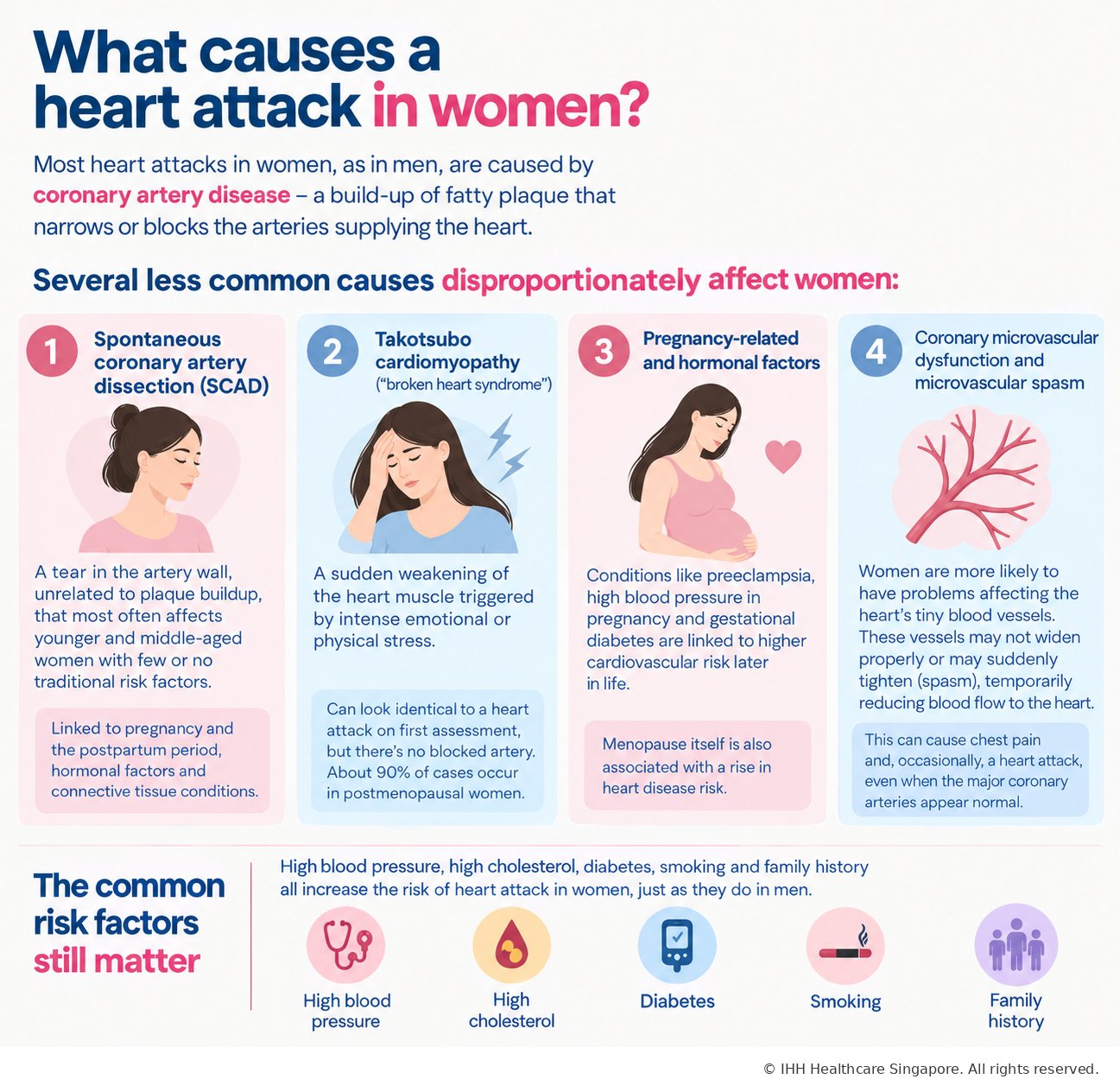
Most heart attacks in women, as in men, are caused by coronary artery disease – a buildup of fatty plaque that narrows or blocks the arteries supplying the heart. Several less common causes disproportionately affect women, and are worth knowing:
None of this replaces the standard, well-known risk factors: high blood pressure, high cholesterol, diabetes, smoking, and family history all matter for women just as much as for men.
A silent heart attack (silent myocardial infarction) is one that happens with minimal, unusual, or no noticeable symptoms, and is often only discovered later – sometimes on a routine ECG – rather than at the time it occurs.
Research on this can look contradictory at first glance. An early, long-running analysis of the Framingham Heart Study found unrecognised heart attacks were more common in women than men (35% vs. 28%) (Kannel, 1986), while more recent population studies using imaging to detect old, undiagnosed heart attacks have sometimes found a higher raw prevalence in men.
Dr Deanna Khoo, cardiologist at Gleneagles Hospital, explains why: "The data is not consistent that silent MIs are more common in women compared to men. Women have a higher likelihood of an MI not being immediately recognised, sometimes because of atypical symptoms. But absolute rates of silent MIs may be overall higher in men due to the higher prevalence of the disease in men overall."
In other words, women aren't necessarily having more silent heart attacks – but when a woman does have one, it's more likely to go unrecognised at the time. What's not in question is how serious that is:
"A silent heart attack is not a harmless one," Dr Khoo adds. "Even when it goes unnoticed at the time, it can damage the heart and carries a similar long-term risk of heart failure, stroke, and death as a heart attack that is recognised when it occurs."
Continuous chest pain lasting 20 minutes or more, not relieved by rest, is a well-recognised red flag and one of the two most common symptoms reported by heart attack patients in Singapore (Singapore Heart Foundation, n.d.).
But for women specifically, symptoms don't always follow this pattern; they can be intermittent, come and go, or build up gradually over hours or even days rather than announcing themselves as one sudden, unmistakable event. This is part of why women's heart attacks are more easily explained away as something else.
The duration or pattern of a symptom shouldn't be used to decide whether it's "serious enough" to act on. If a symptom is new, unexplained, and doesn't have an obvious other cause, it's reason enough to seek emergency care.
A heart attack is an evolving medical event, not a single moment; the longer the blood supply to part of the heart muscle stays blocked, the more permanent damage accumulates. This is the clinical basis for the phrase "time is muscle": treatment to restore blood flow within the first couple of hours has a significantly better chance of limiting lasting heart damage than treatment delayed by many hours.
This is precisely why waiting to see if symptoms "pass" is risky, regardless of how mild or intermittent they seem – the underlying event can still be progressing even while the symptoms feel manageable.
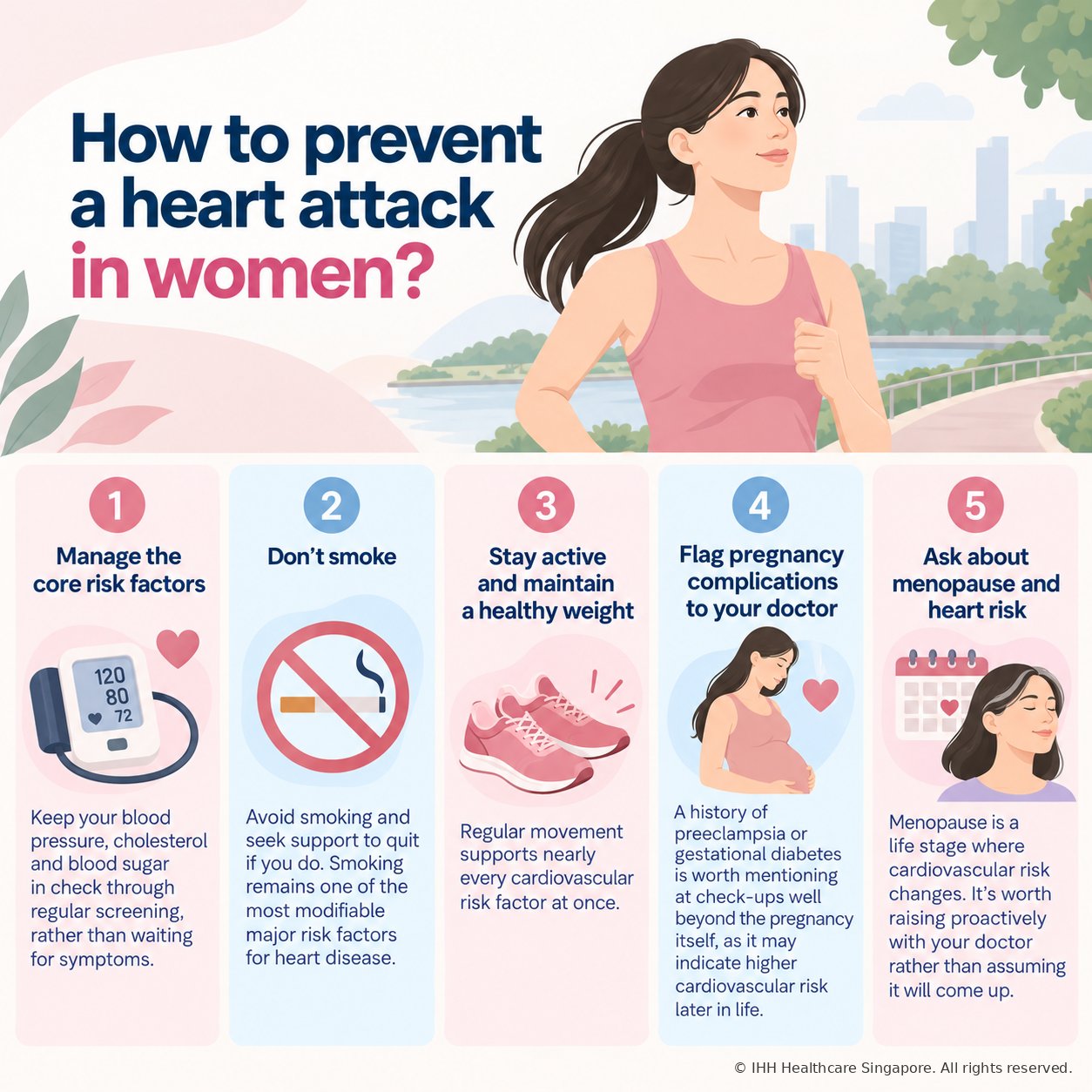
Prevention for women rests on the same core pillars as for men, with a few additional points worth flagging specifically:
It's also worth knowing that awareness among healthcare providers has historically lagged here too – one American Heart Association survey found only 22% of primary care physicians and 42% of cardiologists felt well prepared to address cardiovascular risk specifically in women (American Heart Association, 2024). Asking direct questions about your own heart health risk, rather than assuming it will be raised for you, is a reasonable and useful thing to do.
If you have concerns about your heart health – including family history, pregnancy-related complications, or symptoms that don't feel quite right – speak with a cardiologist. Trusting your own sense that something is wrong is, on its own, a good enough reason to get checked.

This is a phenomenon that has been rearing its head much more in recent years. Athlete or not, it is important to understand its possible causes.

Heart attacks are the 2nd most common cause of death after cancer in Singapore – but help is available for if you are diagnosed and treated early.

Various kinds of jobs create different types of stress, and whether the stress becomes harmful depends on the individual.

Complications arising from diabetes and Peripheral Arterial Disease often result in patients losing a limb, but it does not have to be that way.

It’s not unusual to hear of professional athletes suffering a heart attack at the peak of their game. Cardiologists can provide expert advice to athletes.
We recommend the most common heart operations to beat heart disease.

Our breast surgeon explains how to understand your risk, warning signs to know, why screening matters even when you feel well, and what surgery can look like today.

As knee osteoarthritis progresses, everyday activities can become more difficult. Our pain specialist and orthopaedic surgeon explain the treatment options available and how to find the right approach for you.

Dr Edwin Chng from Parkway Shenton explains why weight loss can slow down during medical weight management, and when it may be time to review your treatment plan.

Prostate cancer is common, often silent, and still diagnosed too late in Singapore. Urologist Dr Tan Yung Khan on what every man should know about screening, diagnosis, and treatment.

We answer common questions about haze, and how this can affect common chronic lung conditions such as asthma and chronic obstructive pulmonary disease (COPD), and 8 simple tips to protect ourselves against it.

Our neurosurgeon, Dr Vincent Ng, explains the factors specialists consider when deciding whether a brain aneurysm should be monitored or treated, and what the different treatment options involve.
Gleneagles Hospital is part of IHH Healthcare, one of the world's largest integrated healthcare networks.

Download the MyHealth360 app to access an array of medical services conveniently.


Get trusted medical advice from our specialists, dietitians and physiotherapists directly in your inbox.
Subscribe