


Dr Wong Siew Wei
Medical Oncologist


 Add as a preferred source on Google
Medical Oncologist
Being diagnosed with prostate cancer today looks very different from what it did even a decade ago. While prostate cancer is the most common cancer among men in Singapore – accounting for 18% of all male cancer diagnoses between 2019 and 2023, according to the Singapore Cancer Registry Annual Report 2023 – it is also one of the most treatable, particularly when caught early.
But even for patients with advanced or metastatic disease, the treatment landscape has shifted significantly.
Medical oncologist Dr Wong Siew Wei at Mount Elizabeth Novena Hospital and Gleneagles Hospital explains how prostate cancer is staged and classified, what systemic treatment options are available today, and what patients and their families should know about living well through and after treatment.
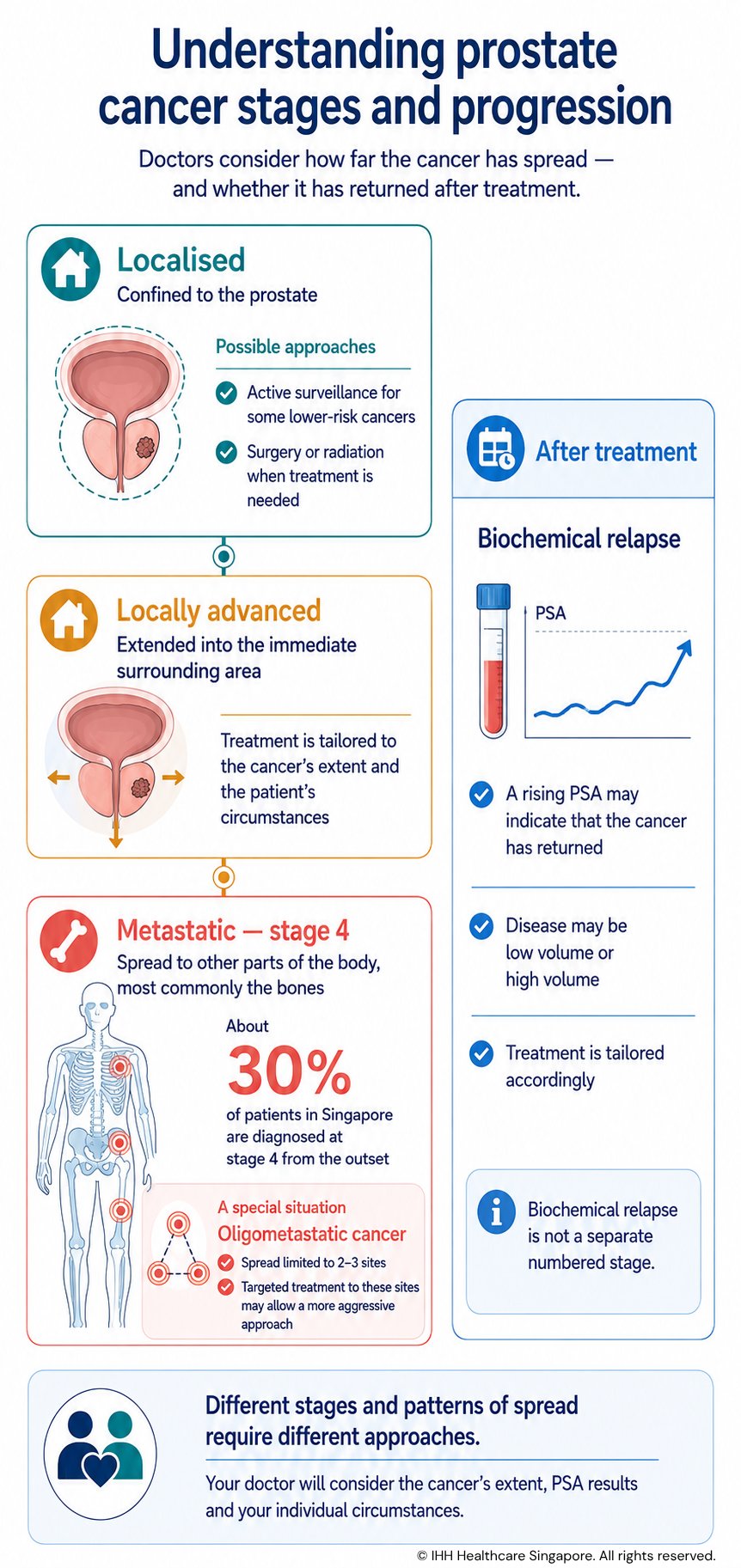
Prostate cancer is broadly categorised by how far it has spread.
In the earliest stages – localised or locally advanced – the cancer is confined to the prostate or the immediate surrounding area. These patients may be offered surgery, radiation, or in some lower-risk cases, active surveillance, meaning close monitoring without immediate treatment.
Some patients who have completed curative intent treatment may encounter rising prostate specific antigen (PSA) level during surveillance – what we call biochemical relapse. Most of these patients will have evident cancer recurrence on sensitive imaging technique using PSMA PET scan.
A very small minority will have no radiological evidence of relapse – a condition termed non-metastatic castration sensitive prostate cancer.
Patients who have visible cancer recurrence, typically in the bones, are labelled as having metastatic castration-sensitive prostate cancer. They are arbitrarily separated into low volume disease (limited spread) and high-volume disease (extensive spread). Prostate cancer patients who develop further cancer progression despite therapy that suppresses male hormone have a condition called metastatic castration-resistant prostate cancer.
In Singapore, about 30% of patients are diagnosed at stage 4 from the outset. It is also worth knowing that there is a group of patients called oligometastatic – where the cancer has spread, but only to two or three sites. This situation may be approached much more aggressively than widespread metastatic disease, with additional ablative treatment to those specific sites offering a real chance at a better outcome.
Prostate cancer care is never delivered by one specialist. Depending on your situation, your team might include a urologist for surgery, a radiation oncologist for radiotherapy, a medical oncologist for systemic drug treatment, a continence nurse, physiotherapists, and in some cases, a genetic counsellor – particularly if DNA testing reveals inherited mutations that could affect your family members.
This multidisciplinary approach matters because different stages and types of prostate cancer require different combinations of expertise. The goal is to ensure that every patient receives a treatment plan that reflects the full picture – not just the cancer, but the person.
Treatment depends entirely on where in the disease journey a patient sits in – there is no one-size-fits-all approach.
For localised disease, options include robotic surgery, radiation therapy, or active surveillance for lower-risk cases.
For more advanced or metastatic disease, the main tools are androgen deprivation therapy (ADT), which suppresses testosterone and starves the cancer; androgen receptor pathway inhibitors (ARPIs), which are tablet-based intensive hormone blockers; chemotherapy for select patients; PARP inhibitors for patients with DNA repair gene mutations; and a newer form of targeted treatment called lutetium PSMA therapy.
Immunotherapy plays a small role, but only in about 2–3% of patients with a specific cancer cell alteration. In many cases, combinations of these are now used – doublet or even triplet therapy – to achieve the best long-term results. Just like most cancers, there are promising emerging therapies beyond the options listed above.
Lutetium PSMA therapy is one of the more innovative treatments available for prostate cancer today. Think of it as a form of targeted radiation delivered from the inside. Rather than directing radiation beams at the body from the outside, we use an injection that carries a radioactive agent tagged to a molecule designed to seek out and bind to the PSMA protein on prostate cancer cell surfaces.
What makes this approach powerful is its precision. The radioactive agent travels through the body and delivers its effect directly to the cancer sites – wherever they are. This means patients whose PSMA PET scan shows high expression of the PSMA protein across multiple sites can potentially benefit, because the treatment finds the cancer rather than requiring doctors to target each site individually.
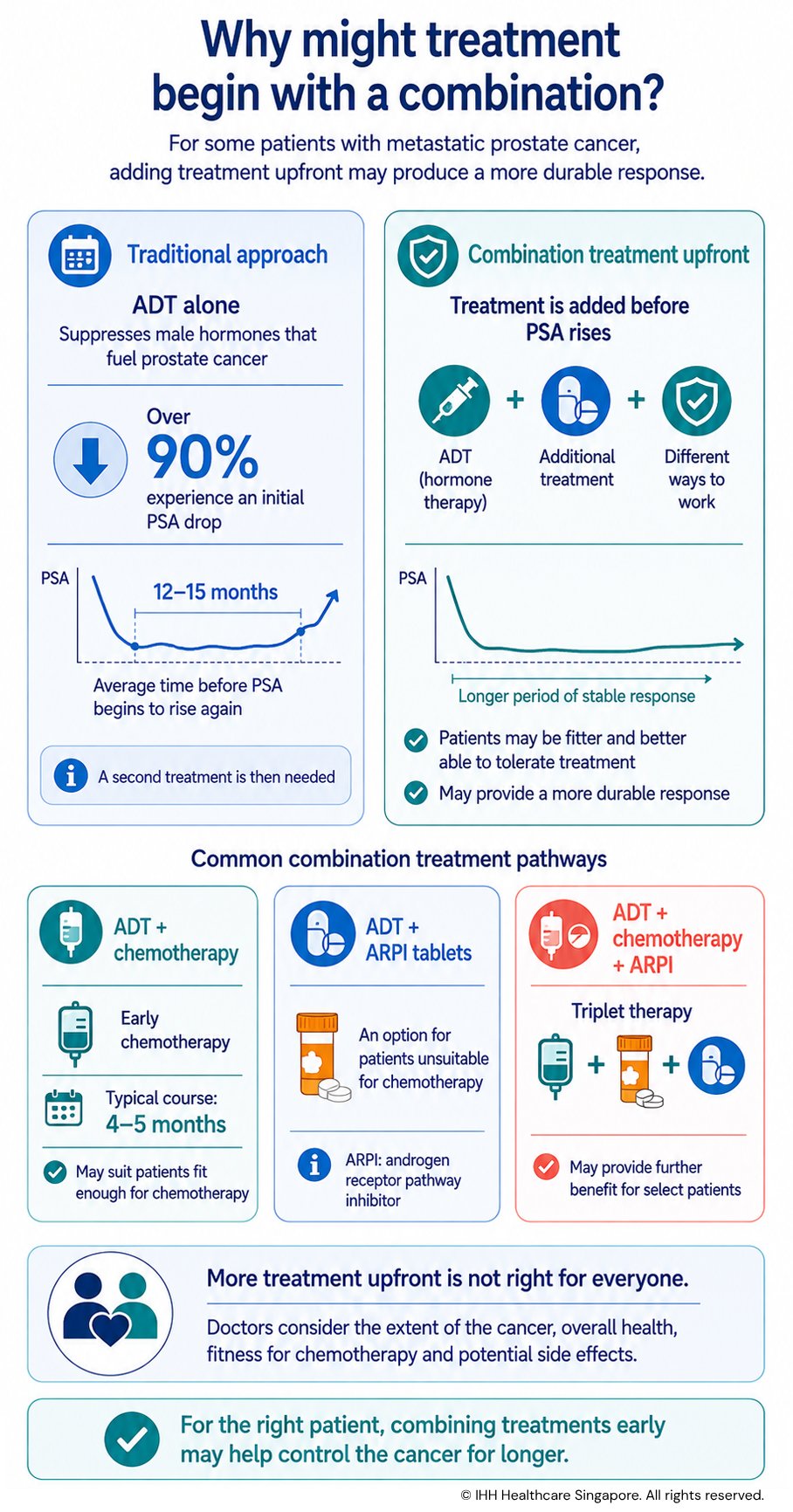
In the past, patients with metastatic prostate cancer were started on hormone suppression therapy (ADT) alone. It works well initially – PSA drops in over 90% of patients – but it is not durable with response typically lasting just 12 – 15 months before PSA starts to rise again.
In 2015, data emerged that adding chemotherapy early – before PSA even rises – produces much more durable results that translate to improved patient survival. Patients are fitter at that point, which means they tolerate chemotherapy better and the course is relatively short: 4 to 5 months.
Subsequently, multiple robust trials showed tablet-based ARPIs combined with ADT also led to longer duration of cancer control and survival. This gives a good option for those patients who are deemed not fit for chemotherapy.
More recently, for select patients, a triplet strategy – ADT plus chemotherapy plus an ARPI – has shown further benefit. The direction of travel is clear: for the right patients, more upfront treatment means a better and longer response. New data has started to incorporate biomarker-driven approach for treatment intensification based on individual patient tumour’s genomic profile.
High-risk localised prostate cancer should not be underestimated.
Patients with high-grade disease (Gleason group 4 or 5), positive lymph nodes, PSA above 20, or stage T3/4 face a 20 to 30% chance of relapse even after definitive treatment such as surgery or radiation. That is a significant risk, and it has shaped how we approach treatment for this group.
For these high-risk patients receiving radiation therapy, we have strong data showing that adding androgen receptor pathway inhibitor on top of hormone therapy improves metastasis-free survival and overall survival. High-risk localised prostate cancer patients who are planned for surgery may benefit from commencement of androgen receptor pathway inhibitor prior to surgery based on recent data.
All high-risk localised prostate cancer should meet with various specialists in the team including medical oncologist, radiation oncologist and urologist on the ideal treatment approach.
For localised prostate cancer – cancer that has not spread beyond the prostate – curative treatment is absolutely possible through surgery and/or radiation.
Even for patients with high-risk localised disease, we can treat with curative intent, though some will benefit from addition of androgen receptor pathway inhibitor and hormone therapy.
For metastatic prostate cancer, the picture is more nuanced. We are not typically talking about a cure, but outcomes have improved dramatically. With the right combination of treatments, patients can remain well and without symptoms for many years.
Treatment decisions are highly personalised and depend on several factors: the stage and extent of cancer, whether prostate cancer is castration-sensitive, genomic profile of the cancer, underlying comorbidities, the patient's age, and crucially – their physical fitness.
For localised prostate cancer, PSA, Gleason grade, T stage and extent of positive cores on biopsy allow patients to be stratified into different risk-categories, with treatment tailored accordingly.
For advanced prostate cancer patients, genomic profiling identifies additional biomarker-driven approach to treat the cancer. All patients with advanced prostate cancer should undergo genomic profiling that covers at least the common DNA repair gene alteration and mismatch repair proteins deficiency.
Singapore has early access to many new drugs that are granted regulatory approval, giving doctors a broad toolkit to effectively treat cancer patients.
Genetic testing has become a standard recommendation for patients with metastatic prostate cancer.
Up to 20 % of these patients have detectable DNA repair gene mutations, with a minority of these mutations being present from birth, while majority of these are acquired mutations in prostate cancer cells.
Testing should not be limited to patients with family history of prostate cancer. This crucial information may guide treatment selection and inform of any cancer predisposition gene that may be inherited.
Patients with DNA repair gene mutations may respond to a class of targeted drugs called PARP inhibitors, which can be added on top of standard treatments. A group of specialists in Singapore published formal recommendations that genetic testing should be offered to all patients with metastatic prostate cancer to guide treatment selection and understand the cancer's biology.
The honest answer is that prostate cancer, particularly in its most common forms, is not preventable – ageing and genetics are the biggest drivers. However, there is something important that lifestyle does influence: your fitness going into treatment.
When I see a newly diagnosed patient, one of the first things I assess is how fit they are. A fit, healthy patient can tolerate more treatment options, including combinations of drugs that we know deliver better outcomes.
So, while we cannot always prevent the cancer, we can absolutely influence how well someone is positioned to fight it. Eat well, stay active, and maintain a healthy weight – not because these will guarantee you won't get prostate cancer, but because they keep more doors open if you do.
Treatment doesn't end at cancer. Patients may live with its side effects, and we take that seriously.
One of the most common concerns is sexual function. Prostate cancer treatment – whether surgery, radiation, or hormone therapy – can affect erectile function and libido. This is partly because the nerves controlling erection sit very close to the prostate, and any treatment targeting the prostate carries some risk of affecting them. Nerve-sparing robotic surgery can preserve sexual function in suitable patients, but the outcome depends heavily on pre-treatment function and tumour size.
Hormone suppression therapy (ADT) brings its own set of side effects, particularly for patients on it for several years: changes in body shape, weight gain, high blood pressure, blood sugar issues, cholesterol changes, accelerated bone loss, reduced muscle mass, and hot flashes. These are alleviated with healthy diet, active lifestyle habits, careful monitoring, and where appropriate, additional medications to protect bone health, reduce hot flashes etc. Patients live longer now than ever before with prostate cancer, so managing quality of life over that time is just as much a part of the treatment as the drugs themselves.

Learn more about prostate cancer treatment and our specialists
Prostate cancer is one cancer, but cancer care at Mount Elizabeth goes much further. From haematology and gynaecological oncology to head and neck cancers and beyond, our specialists work across every major cancer discipline, bringing the same depth of expertise and personalised approach to every patient who walks through our doors.
Learn more
A monthly breast self-examination 7 – 10 days after your period starts can save your life.

It is now possible to customise hearing aids and adapt them to an individual’s hearing loss, age, lifestyle, expectations and preferences.

Kidney cancer is a silent killer, with symptoms usually only showing up in its late stage. Learn about its causes and treatment.

More women are being claimed by breast cancer now than before. Love them by encouraging them to go for breast screening.

Dr Tan Yah Yuen, general surgeon at Mount Elizabeth Hospitals, answers the questions you may have about mastectomies.

Dr Wee Siew Bock, breast surgeon at Mount Elizabeth Hospital, address your questions and concerns about breast conserving surgery (lumpectomy).

Our breast surgeon explains how to understand your risk, warning signs to know, why screening matters even when you feel well, and what surgery can look like today.

As knee osteoarthritis progresses, everyday activities can become more difficult. Our pain specialist and orthopaedic surgeon explain the treatment options available and how to find the right approach for you.

Dr Edwin Chng from Parkway Shenton explains why weight loss can slow down during medical weight management, and when it may be time to review your treatment plan.

Prostate cancer is common, often silent, and still diagnosed too late in Singapore. Urologist Dr Tan Yung Khan on what every man should know about screening, diagnosis, and treatment.

We answer common questions about haze, and how this can affect common chronic lung conditions such as asthma and chronic obstructive pulmonary disease (COPD), and 8 simple tips to protect ourselves against it.

Our neurosurgeon, Dr Vincent Ng, explains the factors specialists consider when deciding whether a brain aneurysm should be monitored or treated, and what the different treatment options involve.
Gleneagles Hospital is part of IHH Healthcare, one of the world's largest integrated healthcare networks.

Download the MyHealth360 app to access an array of medical services conveniently.


Get trusted medical advice from our specialists, dietitians and physiotherapists directly in your inbox.
Subscribe